
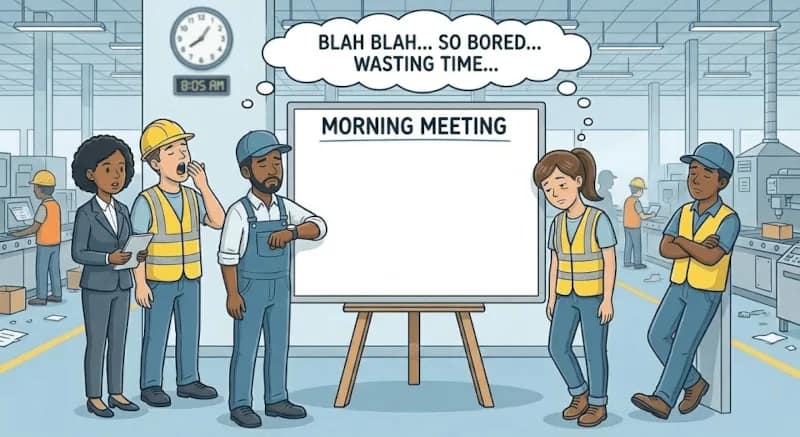
You know those morning huddle meetings where everyone stands around, drinks coffee, and talks about what went wrong yesterday? You know, the meeting where the supervisors and team leads say the same thing day after day, but nothing actually gets fixed. Where people mostly just vent or complain and waste time.
If you want to stop talking in circles and actually start solving problems, you need to use the A3.
Is this what your morning meetings look like? If it is, you need to start making a change. You need to learn to use the A3.
What is an A3, Anyway?

An “A3” isn’t a secret code or a complex software. It’s literally just a piece of paper that is 11 inches by 17 inches (it’s called “A3” size in most of the world).
In the Lean world, we use this one sheet of paper to tell a “story” about a problem. Instead of a 50-page report that nobody reads, you put everything—the problem, the cause, and the fix—on one page so the whole team can see it during the morning huddle.
The Roadmap: How to Fill Out Your A3
Think of the A3 like a map. You start on the left side (The Problem) and end on the right side (The Solution).
The Left Side: Understanding the "What" and "Why"
Before you try to fix anything, you have to be a detective.
- 1. The Background: Why are we even talking about this? (Example: “We’ve been late on 10% of our orders this week.”)
- 2. Current State: What is happening right now? Don’t guess—use facts and drawings. Draw a quick map of the work floor if it helps!
- 3. The Goal: Where do we want to be? Be specific. (Example: “We want 0% late orders by next Friday.”)
- 4. Root Cause Analysis: This is the most important part. Why is the problem happening? Don’t just say “we’re busy.” Use the 5 Whys to get to the bottom of it.
Real Talk: If you don’t find the real “root” of the problem, it’s just going to grow back like a weed.
The Right Side: Fixing the Mess
Once the team agrees on why things are breaking, you move to the right side of the paper to fix it.
- 5. Countermeasures: These are your “fixes.” Based on your root cause, what are we going to do differently starting today?
- 6. The Action Plan: Who is doing what, and when will it be done? During the huddle, assign names to tasks right there on the paper.
- 7. Follow-up: How will we know if it worked? We’ll check back at next week’s huddle to see the results.
Why Use A3s in Your Morning Huddle?
1. It stops the “Blame Game”: When the problem is on a piece of paper in front of everyone, people focus on fixing the paper, not yelling at each other.
2. It’s Visual: You can tape it to the wall. Anyone walking by can see exactly what the team is working on.
3. It Builds “A-Team” Thinking: Since everyone in the huddle helps fill it out, everyone “owns” the solution. No more “that’s not my job” excuses!
Pro-Tip for Your First Huddle
Don’t try to make it look pretty. The best A3s are usually messy, have pencil marks, and maybe even a coffee stain. It’s a living document, not a museum piece. Grab a pencil (or a white board), get the team together, and start drawing your way to a better workday!
Don’t just stand there—make it count! Start your transformation from morning chaos to peak productivity.

Check out the account of SteelPuse Automotive and see how the A3 saved the day! Go to: Paper vs Mistakes: See How it Ends