The To Be Lean House™
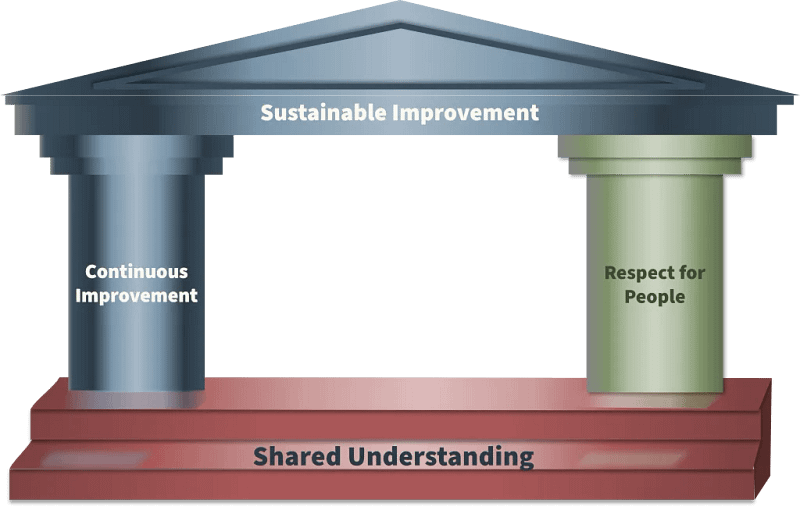
Shared Understanding is the foundation that brings Lean to life.
Most Lean practitioners have seen some version of the Lean House.
The house has helped organizations understand the principles that support continuous improvement for decades.
The To Be Lean House does not replace the traditional Lean House.
Instead, it explores a question that has guided my work for more than a decade:
What helps Lean thrive?
The answer I arrived at was Shared Understanding.
Because sustainable improvement doesn’t happen when only a few people understand the tools.
Sustainable Improvement happens when understanding is shared across all levels of the organization.
Understanding the House
The To Be Lean House is more than a framework.
It is a visual representation of a simple belief:
People support what they understand.
Every part of the house serves a purpose.
Together, those parts explain how Shared Understanding strengthens improvement efforts and helps organizations create lasting change.
The Foundation
Shared Understanding
Every strong house begins with a strong foundation.
In the To Be Lean House, that foundation is Shared Understanding.
Many organizations communicate information.
They launch initiatives.
They introduce tools.
They provide training.
Yet communication alone does not create understanding.
Employees are often left asking:
- Why are we doing this?
- What problem are we solving?
- How does this help?
- How do I use this correctly?
These questions reveal The Understanding Gap™.
Shared Understanding begins closing that gap.
It exists when leaders, supervisors, and employees share enough knowledge, context, and language to participate meaningfully in improvement.
Notice what this does not mean.
Shared Understanding does not require everyone to become Certified or get a Belt.
It does not require everyone to become an expert.
But it does require people to understand enough to:
- Recognize waste
- Solve problems
- Participate in discussions
- Contribute ideas
- Improve processes
Not everyone needs a belt or a certificate.
Everyone deserves understanding.

The Cost of Incomplete Understanding
Many organizations appear to successfully introduce new tools, processes, and initiatives.
People may attend training.
Processes are documented.
New expectations are communicated.
For a period of time, employees may seem to comply with those changes.
But when understanding remains incomplete, that compliance is often temporary.
When the excitement fades and attention shifts elsewhere, the compliance often fades with it.
People may continue following the process for a while, but without understanding, participation remains limited and ownership rarely develops.
Employees may follow instructions without fully understanding:
- Why the change matters
- What problem is being solved
- How the tools work
- How they contribute to success
As a result:
- Improvement becomes fragile.
- Participation remains limited.
- Ownership never fully develops.
- Continuous Improvement struggles.
- Respect for People becomes difficult to sustain.
The result is often temporary improvement rather than sustainable improvement.
Pillar One
Continuous Improvement
Continuous Improvement is one of the supporting pillars of the To Be Lean House.
Most organizations want continuous improvement.
Far fewer create the conditions that allow it to flourish.
Many unintentionally limit improvement to:
- Specialists
- Those with Belts or Certificates
- Managers
- Improvement teams
As a result, improvement becomes the responsibility of a few instead of the opportunity of many.
Shared Understanding changes that.
When people understand:
- Waste
- Flow
- Standard Work
- Root Cause Analysis
- Problem Solving
they become capable of participating.
Participation creates ideas.
Ideas create improvements.
Improvements create learning.
And learning creates more improvement.
Continuous Improvement becomes continuous only when participation becomes widespread.
And participation begins with understanding.
Pillar Two
Respect for People
Respect for People is one of the most important principles in Lean.
It is also one of the most misunderstood.
Many people interpret Respect for People as:
- Being nice
- Listening
- Employee engagement
- Open communication
Those things matter.
But I believe there is another practical expression of Respect for People:
Helping people understand enough to participate.
People cannot contribute confidently if they are left in the dark.
They cannot solve problems using concepts they do not understand.
They cannot fully participate in conversations conducted in unfamiliar language.
Imagine standing outside a room looking through a dirty window.
You can see people talking.
You can see charts on the wall.
You can tell decisions are being made.
But you can’t quite understand what is happening.
You don’t know how the discussion affects you.
You don’t know how you can contribute.
At first, you try to figure it out.
You lean closer.
You try to make sense of what you’re seeing.
But eventually most people stop looking.
Not because they don’t care.
Because they don’t feel included in the conversation.
Many improvement initiatives unintentionally create the same experience.
A small group understands the tools, the terminology, and the objectives.
Everyone else watches from the outside.
Through a dirty window.
Respect for People means helping people see clearly enough to participate.
Shared Understanding helps clean the window.
It provides people with the context, knowledge, and language necessary to engage meaningfully in improvement.
Not because everyone becomes an expert.
Not everyone needs a belt or a certificate.
Everyone deserves understanding.
When understanding is shared:
- Participation increases
- Confidence grows
- Ownership develops
- Respect for People becomes real
How Shared Understanding Strengthens Both Pillars
From Understanding to Ownership
Many organizations want ownership.
Very few understand where ownership comes from.
Ownership is not created through enforcement.
Ownership is not created through compliance.
Ownership develops naturally through understanding.
The progression often looks like this:
Understanding
↓
Confidence
↓
Participation
↓
Ownership
↓
Sustainable Improvement
When people understand enough to participate, they begin investing themselves in the process.
Eventually, improvement becomes something they own rather than something they are asked to do.

Shared Understanding Gives Life to Lean
Lean tools contain tremendous potential.
5S.
Flow.
DMAIC.
A3.
Standard Work.
Root Cause Analysis.
But tools alone do not create improvement.
People create improvement.
And people can only improve what they understand.
Without Shared Understanding:
- Standard Work becomes hesitant compliance.
- KPI boards become wallpaper.
- 5S becomes housekeeping.
- A3s become paperwork.
- Lean becomes a program.
With Shared Understanding:
- Standard Work becomes a shared best practice.
- KPI boards become feedback.
- 5S becomes ownership.
- A3s become critical thinking.
- Lean becomes culture.
The tools have not changed.
The understanding behind them has.
That is why Shared Understanding gives life to Lean.

The Roof
Sustainable Improvement
The roof represents the reason the house exists in the first place.
Sustainable Improvement.
Many organizations successfully launch improvement initiatives.
Far fewer sustain them.
The challenge is rarely implementation.
The challenge begins after:
- The training ends.
- The excitement fades.
- The consultants leave.
- Leadership attention shifts elsewhere.
Sustainable Improvement occurs when improvement becomes part of the culture rather than part of a project plan.
That happens when people understand:
- Why the improvement matters
- What problem is being solved
- How they contribute
- How the tools support success
As understanding spreads:
Participation grows.
Ownership develops.
Improvement becomes self-reinforcing.
That is why Sustainable Improvement sits at the top of the To Be Lean House.
It is not the starting point.
It is the outcome.
The To Be Lean Way of Improving

Most improvement efforts begin with tools.
A new initiative is launched.
Training is delivered.
Processes are documented.
Expectations are communicated.
The hope is that people will adopt the changes and sustain them over time.
The To Be Lean Methodology takes a different approach.
It begins with understanding.
Before people can participate meaningfully, they must understand:
- Why the change matters
- What problem is being solved
- How the tools work
- How they contribute to success
When understanding is shared, confidence begins to grow.
Confidence encourages participation.
Participation develops ownership.
Ownership transforms improvement from an initiative into a culture.
This is the progression at the heart of the To Be Lean Methodology:
The Understanding Gap
↓
Shared Understanding
↓
Participation
↓
Ownership
↓
Continuous Improvement + Respect for People
↓
Sustainable Improvement
The goal is not to create more experts.
The goal is to create more understanding.
Not everyone needs a belt or a certificate.
Everyone deserves enough understanding to participate meaningfully in improvement.
Because improvement doesn’t happen when a few people understand the tools.
Improvement happens when understanding is shared across all levels of the organization.
And when understanding is shared, Lean begins to live.
The Foundation of Sustainable Improvement
Organizations often invest tremendous effort into implementing improvement initiatives.
They launch projects.
They provide training.
They introduce tools.
They document processes.
Yet many improvement efforts struggle to sustain themselves over time.
Not because the tools are ineffective.
Not because employees do not care.
Often, the missing ingredient is understanding.
When understanding becomes concentrated within a small group of trained individuals, everyone else is left trying to make sense of what is happening and why it matters.
It can feel like standing outside a room looking through a dirty window.
You can see that decisions are being made.
You can see improvement activities taking place.
You can hear the language being used.
But you cannot quite see clearly enough to fully participate.
Over time, many people simply stop trying.
Not because they lack interest.
Because they do not feel included in the conversation.
Shared Understanding helps clean the window.
It helps people understand:
- Why improvement efforts exist
- What problems are being solved
- How Lean tools support success
- How they can contribute
This is why Shared Understanding serves as the foundation of the To Be Lean House.
Without it, improvement often depends on a small group of experts.
With it, improvement becomes something the entire organization can participate in.
Not everyone needs a belt or a certificate.
Everyone deserves understanding.
Because improvement doesn’t happen when a few people understand the tools.
Improvement happens when understanding is shared across all levels of the organization.
And when understanding is shared, participation grows, ownership develops, and Sustainable Improvement becomes possible.